


At EdgeNectar, we examine the shift toward physical AI, the architecture enterprises need to support it, and the role of Autonomous Private 5G in connecting cloud, edge and device intelligence.
Key takeaways
- Physical AI needs intelligence distributed across cloud, enterprise edge and device layers — not concentrated in one place.
- Three Layer AI routes each decision to wherever it can be made accurately and fast enough: cloud, enterprise edge or the device itself.
- Continuity has to be designed deliberately — losing the cloud, losing an edge service and losing the radio connection are different failures with different safe responses.
- Governance must cover both what AI can know and what it is authorized to do, not just the answers it produces.
- Autonomous Private 5G is the connectivity foundation that lets physical AI scale across moving devices without a proportional increase in specialist effort.
The next phase of AI will be measured in the work it can perform
AI is becoming part of how enterprises operate. We have seen what powerful models can do with language, knowledge and digital workflows. The next challenge is to bring that intelligence into places where things move, conditions change and decisions have physical consequences.
At EdgeNectar, we see this transition as a defining infrastructure challenge for enterprise technology. A robot in a warehouse, a vehicle on a factory floor or an assistant in a retail store needs access to intelligence that understands the situation in front of it. It must communicate with the systems around it and respond within the limits of its task. Intelligence becomes useful when those capabilities work together.
Physical AI brings that requirement into focus. A response that would be acceptable in a digital conversation may be inadequate in an operating environment. It can arrive after the situation has changed, be based on information from another site or depend on a service that is temporarily unavailable. As enterprises expand their use of AI, these questions become part of the architecture they must design.
At EdgeNectar, we approach this through Three Layer AI: cloud AI, enterprise edge AI and device AI. Each contributes a different kind of intelligence, and each has a different relationship to the operation. Our work in Autonomous Private 5G addresses the communication foundation that connects those responsibilities.
Our view is that the next stage of enterprise AI adoption will reward organizations that can combine model capability with local execution, operational continuity and control. The infrastructure decisions made during this stage will influence how readily useful pilots become dependable deployments.
A practical architecture for intelligence across the enterprise
When people discuss AI, they often begin with the cloud. Cloud services have made advanced models accessible to businesses of every size. An enterprise operating physical systems also needs to consider where each decision should be made.
Three Layer AI is the framework we use to answer that question. It describes how to distribute intelligence across three responsibilities. It is an architectural approach, rather than a new model or a formal industry standard.
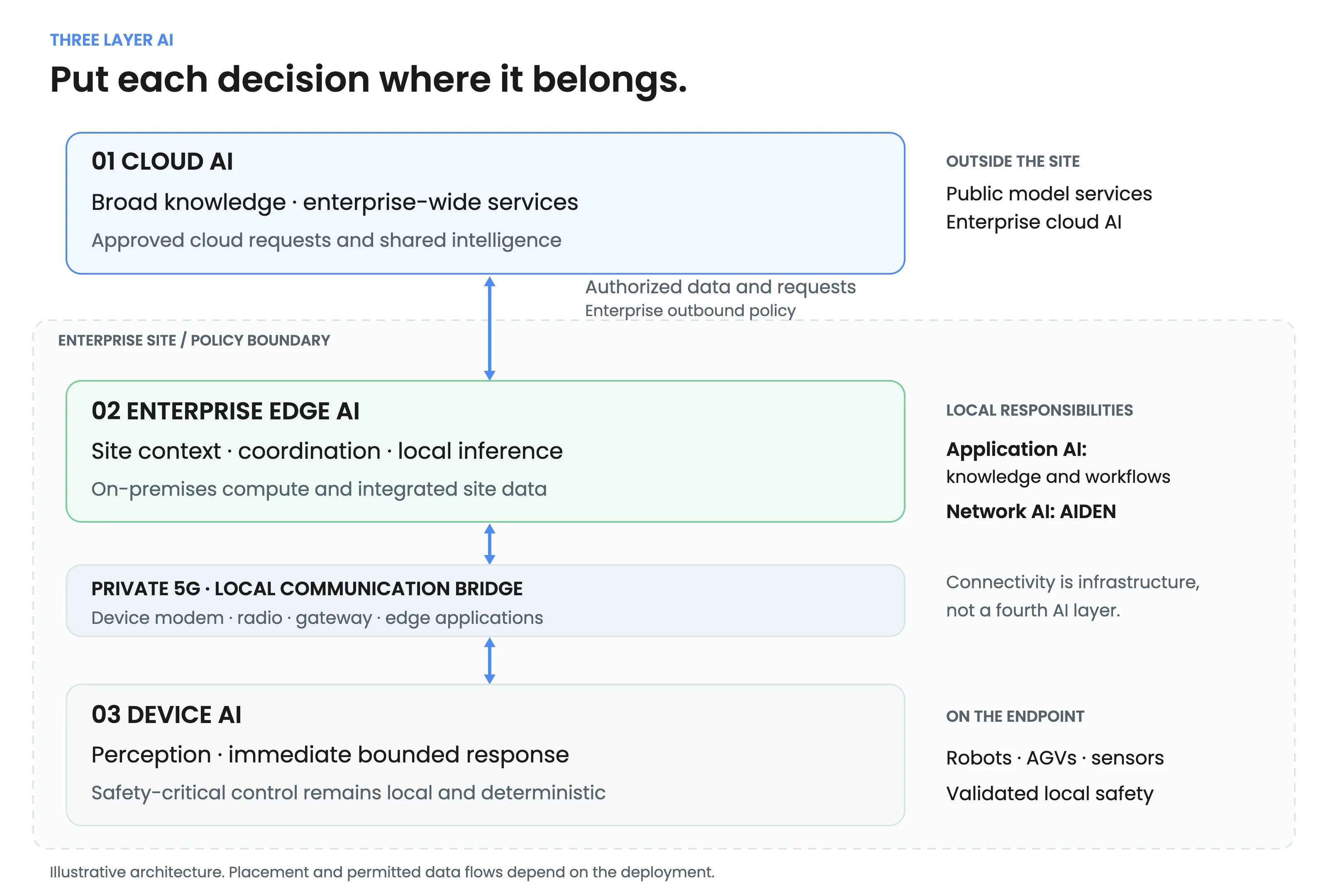
Cloud AI provides breadth
The cloud supports general-purpose models, hosted enterprise services and knowledge that needs to be shared across locations. It is well suited to broader reasoning, enterprise-wide workflows and the development and distribution of approved models. Public model services and enterprise-configured cloud AI both belong in this layer, with different requirements for access and data handling.
Enterprise edge AI provides the context of the site
The enterprise edge sits close to the operation, usually on premises and within the enterprise boundary. It combines local knowledge with current information from devices and business systems. It can support site-specific interactions, coordinate tasks and apply policies before information is sent to the cloud.
This is where an AI system can understand which aisle contains a product, which charging station is available or how a particular facility is organized. The value comes from integrating relevant data and applications with local compute.
Device AI provides perception and immediate response
The device is closest to the physical situation. It senses its surroundings, knows its own condition and handles the responses that must remain local. A robot can recognize an obstacle or respond to its battery state within its validated operating rules. Safety-critical control and emergency-stop behavior remain local and deterministic in this architecture.
The layers do not form a fixed sequence through which every request must pass. A robot can handle a greeting itself, use edge AI for directions and consult an approved cloud service for a broader question. The architecture should route the task to the capability that can answer it appropriately.
In an integration we have configured and tested, we have brought these roles together in a robot interaction: device AI for the initial exchange, on-premises edge AI for site information, and public or enterprise cloud services for authorized requests. The robot remains the human interface while different layers contribute the appropriate knowledge.
This is the foundation we believe enterprises need as physical AI develops: a clear division of responsibility, connected through infrastructure designed for the operating environment.
Four trends shaping physical AI in the enterprise
The direction of investment is becoming visible. NVIDIA’s March 2026 robotics announcement connects simulation, industrial automation and on-device inference. Ericsson’s 2026 technology outlook also identifies physical AI and distributed compute as important drivers of network evolution. These developments reinforce the need to consider intelligence and connectivity together.
For enterprises, we see four developments that deserve particular attention: the distribution of intelligence, the design of operational continuity, control over data and actions, and the transition toward autonomous network operations. Together, they determine how AI can be used in a physical business environment.
Trend 1: Intelligence moves closer to the decision
Physical AI increases the value of current local information and a response that arrives while it is still useful.
What is changing
A cloud model can understand how a retail business works without knowing where a product is located in the store a customer has entered. It can understand logistics without knowing that an aisle has just become blocked. Physical AI makes the relationship between knowledge and location central to the quality of a decision.
Response time matters for the same reason. The time available to make a useful decision depends on what the device is doing. A general question may tolerate a remote response. An immediate reaction to the environment needs to be handled on the device. Coordination between several devices may belong at the site edge.
The architectural consequence
We need to place intelligence according to the task’s context and timing requirements. Enterprise edge AI can combine current site information with local inference and shared knowledge. It can reuse approved answers where appropriate, reducing unnecessary cloud requests and making the local system more useful over time.
That knowledge must remain current. A previously correct answer about inventory, a route or a machine state can become wrong as conditions change. Data freshness, permissions and the rules for updating or invalidating local information belong in the architecture from the beginning.
The timing question also extends beyond the network. Sensing, communication, processing, inference and actuation all contribute to the response. Enterprises need to measure the whole decision path, including occasional long delays that an average figure can hide.
Local paths and cloud paths have different timing characteristics
Our September 2026 technical assessment records indicative observations of about 5–20 ms for the private 5G connection, about 20–100 ms from robot to on-premises edge server, and about 300–400 ms from robot to cloud.
These observations come from varying situations and are not guaranteed service levels or a controlled comparison. The private-5G portion is included within the robot-to-edge figure. They should not be interpreted as complete AI inference or action-response times.
The next priority for enterprises
We recommend starting by mapping the decisions that make an application useful: the information each requires, how quickly it must respond and the actions it is permitted to take. That map determines which capabilities belong on the device, which belong at the enterprise edge and which can benefit from the cloud.
Trend 2: Continuity becomes an architectural requirement
The ability to continue useful local work will increasingly influence whether physical AI can become part of everyday operations.
What is changing
One question from our customers captures this requirement clearly: if the internet is unavailable, can the AGVs still run and can the warehouse continue working? For a physical operation, dependence on a remote service can turn a connectivity interruption into a business interruption.
A distributed architecture creates options for reduced local operation, but those options must be designed. Losing cloud access, losing an edge application and losing the local radio connection are different events. Each removes a different set of capabilities.
The architectural consequence
When cloud access fails, eligible functions can continue on the enterprise edge if their models, data, authorization and local communication path remain available. When an edge service fails, the device can retain its own bounded capabilities. If the device loses its network connection, its local safety behavior must still be available.
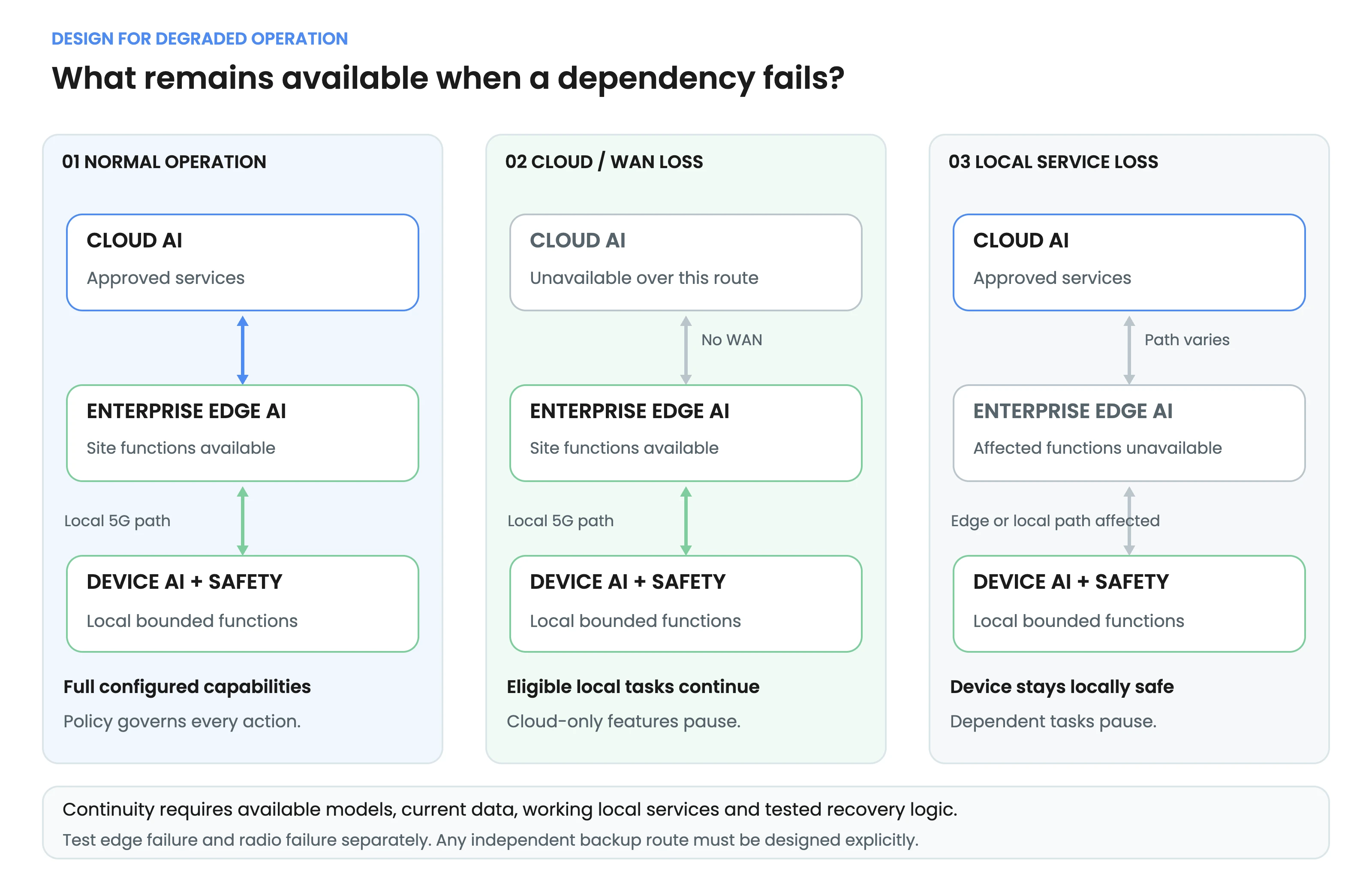
The layers support resilience through defined responsibilities and operating modes. They do not automatically replace each other. An edge system cannot reproduce a cloud-only capability that has never been deployed locally, and a robot cannot take over a fleet-coordination function without the required information.
Restoration is part of continuity too. Sessions need to reconnect, queued events need to be reconciled and completed actions must not be executed again because an old command arrives after recovery. Application health checks need to detect whether a service can actually perform its task.
The next priority for enterprises
We recommend testing these conditions separately, with the real application and devices. Remove WAN access, stop an edge service and interrupt the radio path. Observe what continues, what pauses and when a person must intervene. That evidence provides a useful basis for deciding how to scale.
Trend 3: Enterprise control expands across data and actions
As AI gains access to operational information and physical workflows, governance must cover the complete interaction.
What is changing
In many discussions about AI, attention goes to the answer. We believe enterprises should pay equal attention to the request. A prompt can reveal a confidential process. A camera stream can expose a work area. A spoken question can include customer information. The context needed to produce a useful answer may be commercially sensitive.
Physical AI also connects information to action. Access to knowledge, permission to propose a task and authority to execute it are separate responsibilities. A system may be allowed to explain a process without being allowed to change it.
The architectural consequence
The enterprise edge provides a place to apply local policy, process selected information on premises and control which requests leave the site. Cloud services remain valuable within those boundaries. The architecture should make their use explicit, with a defined purpose and authorized access.
Local placement alone does not establish security. Devices and workloads need identities. Enterprise knowledge needs access controls. Operational, management and external traffic need appropriate separation. Retention and incident records need to reflect the sensitivity of audio, video, telemetry and commands.
NIST’s March 2026 guidance for 5G infrastructure describes separating data, control and operations-and-maintenance traffic. Above that infrastructure, enterprises must also govern the application identities and actions that use the network.
The next priority for enterprises
The first step is to map what each device and service may know, request and do. From there, organizations can define which information stays local, which may be shared with approved cloud services and which actions require human authorization. Clear ownership of these decisions will be essential as AI is deployed across more sites.
Trend 4: Autonomous Private 5G becomes a foundation for mobile AI
Scaling physical AI requires communication that can support moving devices and an operating model enterprises can sustain.
What is changing
A small pilot can succeed with close supervision and a few connected devices. A fleet operating across a warehouse introduces movement, handovers, changing radio conditions and competing traffic. Cameras, voice interactions and telemetry place different demands on the same infrastructure.
The network needs to support those differences while remaining manageable for the enterprise. Specialist effort, recurring interruptions and long recovery times can limit the value of an otherwise capable AI application. As physical AI expands, network operations become part of the economics of AI adoption.
The architectural consequence
This is the role we are developing for Autonomous Private 5G at EdgeNectar. We combine standards-based cellular connectivity with an enterprise-oriented architecture and AI-driven network operations. The aim is to connect physical AI to local intelligence while reducing the complexity of maintaining that communication environment.
In the Three Layer AI architecture, a robot’s compatible modem communicates through the private 5G radio and a local gateway to enterprise edge applications. Approved requests can continue to cloud services through the enterprise’s outbound path. Private 5G supplies the communication bridge; the application layers determine how information is interpreted and which decisions are made.
5G provides mechanisms for differentiated quality of service. Those capabilities need to be supported, configured and monitored for the actual application. 5G-ACIA’s industrial guidance explains how applications can request appropriate QoS and observe the service they receive.
Our edge AI engine, AIDEN — AI Delivery Edge Network — addresses network management. It supports our approach to predictive management, self-healing and recovery. Its responsibility is distinct from the application AI that coordinates a robot task or answers a customer question. Both can operate at the enterprise edge, supporting different parts of the same operation.
Local network operation during cloud loss is an important part of this design. When the gateway, radio and required local services remain healthy, the local communication path can support eligible site functions. The application must still be designed to work with the capabilities available locally.
The next priority for enterprises
The choice of connectivity should follow the operating environment. Private 5G is especially relevant where mobility, managed wireless communication and local control are important. Wi-Fi and wired connections can remain appropriate elsewhere. Coverage, capacity, device compatibility and application behavior need to be measured at the site.
The investment case should include the cost of deployment, integration, spectrum, compute and ongoing support, together with the effect of interruptions on productive work. We expect the value of autonomous network operations to be judged increasingly by completed tasks, shorter recovery and reduced operator effort.
The road ahead: build for the operation you want AI to support
The opportunities for physical AI are broad, but implementation will progress through specific tasks in specific environments. NIST’s robotics research highlights the remaining gap between research demonstrations and practical manufacturing use, including the need to assess productive output, cost and safety. These are the measures that matter when technology becomes part of a business operation.
Our expectation is that enterprises will increasingly evaluate AI infrastructure through the relationship between capability, locality and control. More powerful models will expand what can be attempted. Better integration of site data will improve the relevance of decisions. Clear operating modes will help organizations manage interruptions. Autonomous connectivity will support the communication path as devices and applications scale.
Three Layer AI brings those requirements into a practical framework. Cloud AI contributes broader knowledge and enterprise-wide services. Enterprise edge AI connects that intelligence to the current site. Device AI provides perception and immediate response. Autonomous Private 5G connects moving devices with local compute and approved cloud resources.
At EdgeNectar, our focus is the communication foundation that makes this architecture usable for enterprises. We are working toward a future in which adopting physical AI is supported by networks that can be operated with less specialist effort and more local control.
The next step for business leaders is to define the operation they want AI to support, then design the intelligence, data flows and connectivity around it. That is how physical AI can move from an interesting capability to a dependable part of everyday work.
Autonomous Private 5G for Physical AI
Let’s design the connection to your operations
Our team can help you explore the communication requirements between your devices, enterprise edge and approved cloud services.
Further reading
- Ericsson, Technology Trends 2026
- NVIDIA, NVIDIA and Global Robotics Leaders Take Physical AI to the Real World, Mar 16, 2026
- NIST, Physical AI and Data Generation for Robotics
- 5G-ACIA, 5G QoS for Industrial Automation
- NIST, 5G Network Security Design Principles, March 2026
Technical examples and indicative latency observations draw on EdgeNectar’s September 2026 Three Layer AI assessment. The outlook expresses EdgeNectar’s perspective; external references provide industry context. Sources reviewed Sep 30, 2026.