


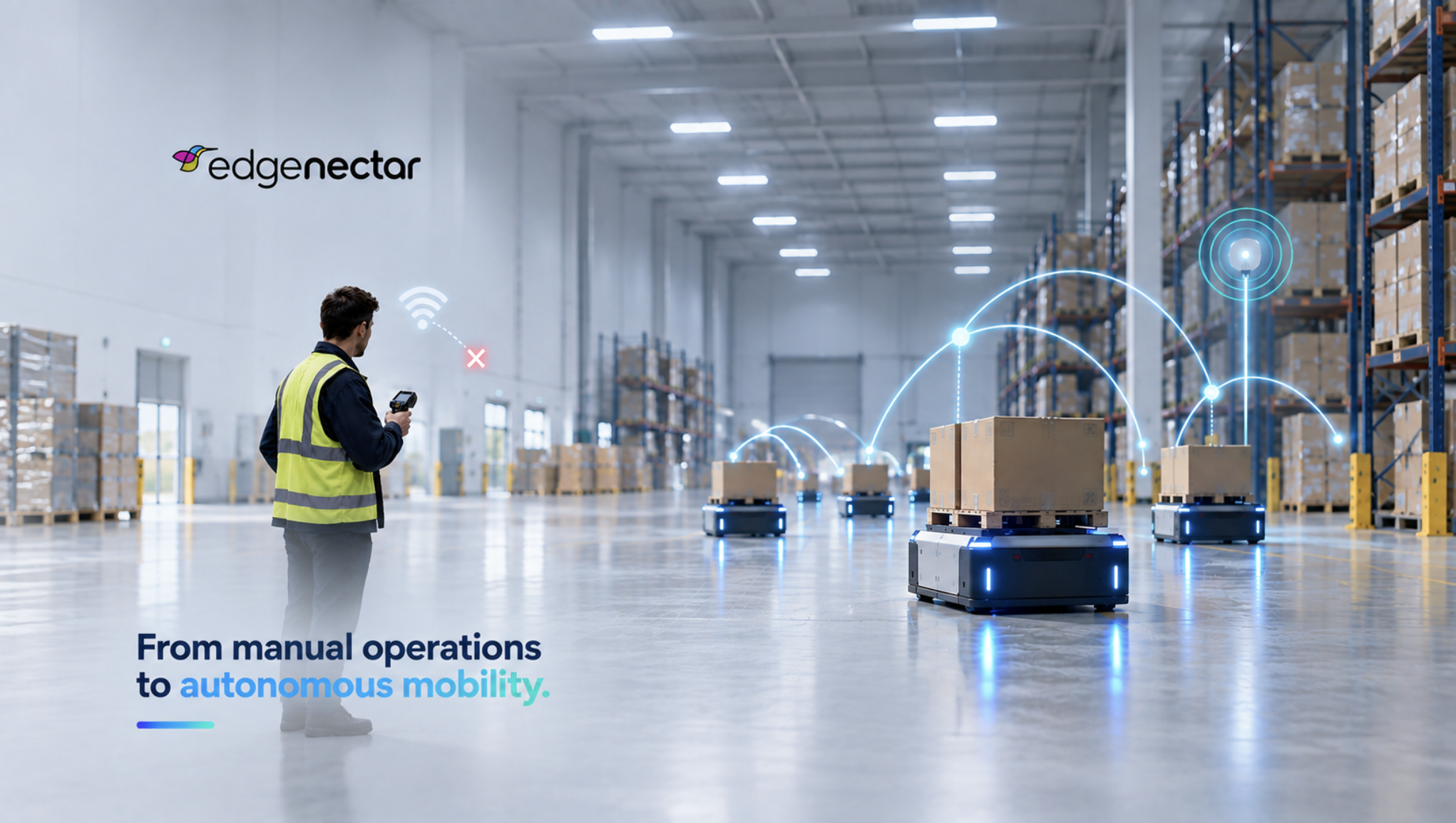
Why warehouse Wi-Fi reaches its limit when the operation starts to move.
Summary
As operations in warehousing move from manual and fixed systems toward autonomous mobile robots, the demands placed on wireless infrastructure change fundamentally. A brief connectivity issue that causes only a minor inconvenience for a human operator can stop an entire autonomous vehicle fleet, disrupt traffic flow and create minutes of lost productivity, quickly compounding through the day.
This article examines why traditional warehouse Wi-Fi becomes harder to manage as robot fleets grow, focusing on roaming, cell size, changing warehouse environments and network predictability. It also explores where private 5G can provide a stronger foundation for mobility-intensive operations, while recognizing that Wi-Fi still remains the right solution for many warehouse applications. The key shift is not simply from Wi-Fi to 5G, but from treating connectivity as an IT service to treating it as part of the operational infrastructure that automation depends on.
1. Introduction
Warehouse automation has for most of time meant bringing work to a fixed point where the systems and devices are stationary. What we see now is that the warehousing model is moving towards autonomous mobility, with robots moving across the warehouse floor, making decisions, and communicating with fellow robots. Though, there is one major problem most warehouses adopting robotics are encountering: the network.
2. What changed
The decisive change is that the end device has moved from being held by a person, to being a fully autonomous robot making the decisions themselves. The median new AMR deployment was around 15 robots in 2024 and roughly 35 per facility by 2026, with the fastest-growing bracket being fleets of 50 to 100 units at mid-market logistics providers and retailers. [1]
When a manually handled device, such as a handheld scanner, drops its connection and a scan fails to register, the operator is a great correction layer who can act even if the connection is lost. The person can move a couple feet to the side, hold the scanner up in the air, or otherwise knowingly correct the connection. It causes some seconds of delay and mild irritation, but most importantly there is no escalation. It shows the network is not enough, but it registers more as a remark than something causing the whole operation to stop, or even a safety issue.
When warehousing now moves to robots, this human correction layer no longer exists. When an AGV loses its session with the fleet manager it completely stops and cannot always re-connect itself, whether it finds itself between access points, or the signal is blocked by metal racks. If the signal can be re-associated, it must then re-authenticate, resynchronise with the traffic plan, and re-enter a lane that now has other vehicles queued behind it. If the connection was lost in the middle of a lift, there is a good chance the products were also dropped to the floor during the reconnection phase. Even if the wireless event lasted under a second, the recovery is measured in several minutes, where a stopped vehicle is simultaneously a physical obstruction.
(safe behaviour)
fleet manager
queue behind clears
A stopped robot is also a physical obstruction: other robots reroute or queue behind it.
Figure 1. The same wireless interruption produces a three-second inconvenience for a person and a multi-minute throughput loss for a fleet. The failure mode is identical; only the cost differs.
3. Four structural mechanisms
What follows is an account of four properties of Wi-Fi that were harmless when endpoints were slow and human-held. The mechanism matters more than the verdict, because the mechanism is what tells an operations team what to test.
3.1 The handover belongs to the client
In Wi-Fi, the decision to leave one access point for another belongs to the client device. The infrastructure can assist: 802.11k supplies a neighbour report listing candidates, and 802.11v allows the infrastructure to send a transition request. Both are advisory. Cisco’s documentation describes the neighbour report as information the client may use should it choose to, and network-assisted roaming as the infrastructure being able to suggest a roam. [2]
At each boundary the client must scan, authenticate and associate again. On a secure enterprise WLAN that exchange runs roughly 500 to 1,200 milliseconds; 802.11r Fast BSS Transition reduces it to under 50 milliseconds, but only where every client in the fleet implements it correctly, which makes fleet performance a function of the worst-implementing radio in the building. [4]
In 5G the sequence is reversed. The device measures and reports; the network selects the target and commands the handover, carrying the session across the boundary rather than rebuilding it afterwards. [3]
Wi-Fi
the client device decides when to leave
Private 5G
the network decides and commands the move
Figure 2. The same journey across three cells. In Wi-Fi each boundary is a rebuild the client initiates; in private 5G it is a handover the network commands.
3.2 Cell size decides how often that happens
The interruption above matters in proportion to how often a vehicle encounters it, and that is a function of cell size rather than protocol. In warehouse conditions a single access point typically covers 3,000 to 8,000 square feet, which is why an 850,000-square-foot distribution centre needs access points in the hundreds. [5]
Private 5G operating at sub-6 GHz covers substantially more floor per radio and penetrates racking better, requiring notably fewer radio units for the same building. [6, 9]
The consequence is easy to miss and is the more important half of the argument. Larger cells do not make roaming faster. They remove roaming events. A vehicle running a 400-metre route crosses a boundary far fewer times, and each crossing avoided is a failure mode that cannot occur.
The same 850,000 sq ft distribution centre floor, covered two ways
Figure 3. The same floor covered two ways. The relevant output is not the equipment count but the number of boundaries a moving vehicle must cross during a shift. Every boundary between cells is a handover, and every handover is an opportunity for the interruption in Figure 1. Larger cells do not make roaming faster. They remove roaming events.
3.3 The floor changes; the survey does not
Loaded pallet racking attenuates signal by roughly 5 to 12 dB per rack row, so a survey performed in a partially stocked building produces a design that is wrong precisely at peak season. Design guidance is explicit that warehouse surveys should be conducted at full rack occupancy; most are not. [5, 7]
Height compounds it. A handheld scanner sits at chest height; a vehicle antenna sits near the floor, below the racking, in the part of the building with the most metal and the least line of sight. That floor-level picture governs the fleet and is rarely the one surveyed.
Then the layout itself moves. Racking is reconfigured, stock profiles shift seasonally, new robotic cells and equipment are installed, and pallets are staged in aisles that were clear on commissioning day. Any wireless design validated against a particular geometry is progressively serving a different one, which is how a network that passed acceptance testing degrades without anything on the network having been changed.
3.4 Priority is not scheduling
Wi-Fi is listen-before-talk; every device contends for airtime. Vehicle traffic is unlike laptop traffic — small frames, high frequency, uplink-heavy, sensitive in the tail rather than the mean. An average latency of 15 milliseconds with a 99.9th percentile of 800 milliseconds is materially worse for a fleet than a steady 30 milliseconds. Fleets are stalled by variance, and variance is what averages are designed to hide. WMM provides priority classes; a cellular scheduler allocates transmission opportunities. That is a structural difference rather than a configuration setting.
4. The density paradox
These mechanisms interact, and the interaction defeats the intuitive remedy.
When vehicles stall in particular aisles, coverage looks like the obvious cause, and the standard response is to add access points. More access points raise co-channel interference, because non-overlapping channels are finite. Containing that interference means reducing transmit power, which shrinks cells. Smaller cells mean more boundary crossings per vehicle per hour — and section 3.2 established that boundary crossings are the thing you were trying to reduce.
The density paradox: why adding access points can make a mobile fleet less reliable
The standard remedy for a coverage gap feeds directly back into the roaming problem
Figure 5. Density and roaming pull against each other. The remedy and the fault share the same control surface, which is why these problems persist through several rounds of remediation.
This is worth stating plainly, because it explains a pattern that otherwise looks irrational: a facility spends money on additional access points, measures no improvement, and concludes the robots are at fault.
5. What the scanner deployment does not show
An EdgeNectar deployment in an 850,000-square-foot distribution centre replaced 200 industrial access points and 200 Wi-Fi barcode scanners after reported disconnects at peak, dropouts in high racks and metal-rich aisles, and delayed scan-to-database updates. Following migration to private 5G with pre-provisioned devices, the reported outcomes were 99.99% connectivity reliability, 32% faster peak picking throughput, no maintenance labour for network operations, and return on investment inside 16 months. [6]
That is a scanner workflow, and its throughput figure should not be presented as a robotics result. It is included here for two narrower reasons. First, the reported symptoms map onto the mechanisms in section 3, which establishes that those mechanisms produce measurable losses in a real building of this type. Second, the migration from 200 access points to notably fewer radio units is the coverage economics of section 3.2 observed in practice rather than argued from specification sheets.
The available inference is modest and still useful: those mechanisms cost a scanner operation — the forgiving case, where a person absorbs every error — roughly a third of its peak throughput. A vehicle fleet runs the same mechanisms with nobody absorbing anything.
6. Where Wi-Fi fits, and what it costs to push past it
6.1 What Wi-Fi is good at
Wi-Fi is well engineered for the conditions it was designed around, and a warehouse contains a great deal of traffic that meets them: offices, back-of-house systems, contractor access, handheld work, general enterprise use. For the job it was specified to do, it remains both the correct answer and the cheaper one, and no automation programme should be replacing it there.
Wi-Fi is not the wrong technology. It has operating conditions.
The relevant question is whether your facility still meets them
Conditions where Wi-Fi performs well
- Endpoints that are stationary or move slowly
- A person in the loop to absorb a failed transaction
- Workloads tolerant of a retry
- Moderate, predictable device density
- A layout and inventory profile that stays stable
- Average throughput as the meaningful measure
Most warehouse offices, back-of-house and general enterprise traffic sit firmly here.
Conditions an autonomous fleet introduces
- Continuous motion at speed, across cell boundaries
- No human to absorb anything
- Coordination that fails safe, and so fails visibly
- Device density rising with every fleet expansion
- Racking and stock that reshape the RF environment
- Tail latency, not average, as the binding constraint
Every one of these removes a condition the left-hand column depends on.
Figure 6. Wi-Fi has operating conditions rather than a verdict. An autonomous fleet systematically removes the conditions in the left-hand column.
6.2 What it costs to engineer a WLAN for a fleet
A properly designed warehouse WLAN can run vehicles. Surveyed at full rack occupancy, with 802.11r, k and v functioning end to end across every client, a dedicated operational SSID, DFS kept away from operational traffic, and access point placement built for aisle-level rather than ceiling-level propagation, it is achievable. [2, 5, 7]
The expense is not principally in the equipment, as initial build costs for enterprise-grade Wi-Fi and private 5G are broadly comparable. [9] The expense is that this design has to be re-achieved, repeatedly, by someone.
Every racking reconfiguration alters the propagation the survey validated. Every additional robot vendor introduces a radio module whose Fast Transition behaviour has to be qualified end to end before the fleet can rely on it. Every fleet expansion adds contenders to a shared medium and may force another review of access point density, channel plan and transmit power. None of these are faults in the installation. They are the ordinary consequences of the building and the fleet doing what they are supposed to do.
Figure 7. The comparison that decides the budget is not equipment against equipment. It is the recurring engineering each model requires as the fleet grows and the building changes.
For a mid-market facility with a small-person IT function, that recurring engineering is the real expenditure. It also scales with precisely the two outcomes a successful automation programme produces: more vehicles, and a building that keeps changing to accommodate them.
6.3 Three limits that engineering does not remove
Three constraints are architectural rather than configurable. A well-run WLAN manages them; it does not retire them, and they do not diminish as the fleet grows.
Spectrum is shared and uncoordinated. The 2.4 and 5 GHz bands are unlicensed. A neighbouring tenant’s deployment, a DFS radar event, or any other emitter arrives as variance nobody in your building caused and nobody in your building can control. Private 5G on CBRS is also shared spectrum — but assignment is coordinated by a Spectrum Access System, and a protected licensed tier exists. The difference is a coordinated regime against an uncoordinated one, not exclusivity against sharing.
Adding access points does not add proportional capacity. Additional access points draw on the same finite set of non-overlapping channels, so density raises co-channel interference; containing that interference means lowering transmit power, which shrinks cells and multiplies the boundary crossings section 3.2 identified as the problem. Coverage and capacity trade against each other, and in a high-bay metal building that trade has no clean resolution.
Contention is structural. Under listen-before-talk, every additional device competes for the same airtime, and a single slow client consumes a disproportionate share of it. More devices therefore means less airtime each, by design rather than by misconfiguration. Cellular capacity is finite too, but it is allocated by a scheduler, so it degrades predictably under load instead of collapsing into contention. [8]
6.4 The arithmetic that matters to an operations leader
A fleet is purchased to raise throughput, and that business case assumes the vehicles run at rated speed for the length of the shift.
When connectivity cannot be relied upon, the available mitigation is to slow the robots down until stalls fall to a tolerable rate. That decision is rational, it is quick, and it is common. It also spends the productivity the fleet was bought to deliver — the throughput gain is traded away to compensate for the network, and it is traded away permanently, because nothing about the underlying limits changes on its own.
This is why the network belongs inside the automation business case rather than the IT budget. A connectivity decision that leaves vehicles operating below rated speed has not saved money on infrastructure. It has reduced the return on a far larger capital investment in robots, and it will keep reducing it for as long as the fleet runs. The comparison worth making is not access points against radio units. It is the recurring cost of holding a WLAN to fleet-grade performance, against the cost of infrastructure specified for mobility from the outset — both measured against the throughput they exist to protect.
7. Conclusion
The wireless failure modes described here are not new. They were present in the scanner-era warehouse and failing in exactly the same way, into a human who absorbed them. Automation removes that absorption layer and leaves the mechanisms where they were.
The practical consequence is that connectivity has changed category. In a facility where vehicles coordinate through the network, the network is part of the material handling system rather than an IT service supporting it, and should be specified, tested and owned accordingly. Facilities evaluating a fleet expansion should test at full racks, at vehicle antenna height, on real routes, measuring tail latency and recovery time rather than average throughput — and should agree with their robotics vendor what the vehicle does at 200 milliseconds of silence, at 2 seconds, and at 20.
The mobility shift is already underway in the relationship between robotics and infrastructure. Planning for it begins before the next fleet reaches the floor.
References
- [1] Robotics Center. Warehouse Robotics 2026: AMR fleet size and deployment brackets. roboticscenter.ai
- [2] Cisco. Understand 802.11r / 11k / 11v Fast Roams on Catalyst 9800 Wireless Controllers. cisco.com
- [3] Ericsson. 5G Advanced handover: L1/L2 triggered mobility. Measurement reporting and network-side handover decision. ericsson.com
- [4] Purple. Wi-Fi roaming and handoff (802.11r / 802.11k); resolving roaming issues in corporate WLANs. purple.ai
- [5] HPE Aruba Networking. Warehouse WLAN design guide: racking attenuation, AP coverage, dynamic inventory. arubanetworking.hpe.com
- [6] EdgeNectar. Private 5G for warehouse automation. Vendor-published distribution centre case study. edgenectar.com
- [7] 2M Technology. Warehouse Wi-Fi design: pallet-load attenuation per rack row; DFS radar-detection suspension. 2mtechnology.net
- [8] 5G-ACIA. 5G capabilities: industrial requirements, quality of service and non-public networks. 5g-acia.org
- [9] EdgeNectar. Future-Proofing Warehouses: Leveraging AGVs and Private 5G Networks. White paper. Download PDF