

In a conversation with Ken Zhang, the CEO of EdgeNectar Inc. describes a preconfigured, plug-and-play system designed to be brought live from unboxing to a fully operational network in 10 minutes. It is an ambitious claim for technology Zhang himself describes as having hundreds, if not thousands, of interfaces and parameters. It also captures the business he is building: bring cellular networking into an organization in a form its IT team can understand and use.
“We want to take out the complexity,” he says.
Zhang describes nearly 20 years at Ericsson, including responsibility for research and development in the Asia-Pacific region, and a career spanning successive generations of mobile technology. He also spent four years leading a global internet company. EdgeNectar, which was founded in mid-2020 during the pandemic, draws on both experiences. He describes a Delaware-registered business with its main office in San Jose, a support office in Dallas, and an office in Asia serving the Asia-Pacific market.
The telecom knowledge is there. The ambition is to deliver it in the language of enterprise IT.
Why physical AI needs a network
Ask Zhang what is driving demand for private 5G and he turns to physical AI: intelligence operating through devices in the real world.
He divides the picture into three parts. AI can run in the cloud, on local edge computers, or on devices such as phones, robots and sensors. EdgeNectar’s role is to provide the communication between moving devices and nearby computing. Zhang describes placing its 5G gateway alongside that local computing capacity, with an AI engine at the same location.
“Edge AI without connectivity is useless,” he says.
His examples include airport barcode scanners and push-to-talk devices as well as robots. Each needs a connection to participate in the wider system. That is where Zhang places the company: in the communication layer that allows those devices to work together.
He acknowledges that Wi-Fi is useful. His case for private 5G rests on what he calls “deterministic” quality of service: the ability to define the service a device needs and keep it predictable. In his account, Wi-Fi performance can vary as the number of users changes. For enterprise applications that depend on consistent connectivity, he argues, private 5G offers a different proposition.
Taking operator complexity out of the enterprise
Zhang’s explanation of lengthy telecom deployments for the traditional model begins with legacy systems. A mobile operator may have equipment, billing and management systems from numerous vendors, all of which need to work together. Standards make those connections possible, but integration and testing take time. He says even a software upgrade can involve months of work.
An enterprise buying connectivity has a different starting point. Its staff understand IT, and Zhang wants EdgeNectar to meet them there.
“They understand IT language. They don’t understand telecom language,” he says.
He describes an integrated system that connects to a local internet router, detects the addressing and adapts automatically. Devices join using a SIM card, or an eSIM where supported. He attributes the quick setup to two decisions: removing software functions enterprise customers do not need, and automating network management through EdgeNectar’s AI Delivery Edge Network, or AIDEN.
The same reasoning extends beyond installation. Zhang describes customers whose devices keep working without staff giving much thought to the network underneath. He wants that lack of day-to-day attention to be a feature of the product.
The case for keeping data close
Connectivity is only part of Zhang’s argument. He also sees data sovereignty, the ability to control where information is handled, as a reason enterprises are considering private networks.
He uses a hospital as an example. Patient information gives an organization a strong reason to care about the path its data takes. Zhang describes EdgeNectar’s network as operating inside the customer’s firewall, with local infrastructure providing an alternative to sending traffic through an external operator’s network or processing it in a public cloud.
For his enterprise pitch, the important point is control. A customer considering AI must think about where information travels as well as what the model can do with it. Zhang presents private connectivity and local computing as parts of the same decision.
Why the economics are changing
Zhang names four forces behind adoption: physical AI, data sovereignty, enterprise access to radio spectrum, and cheaper hardware.
On spectrum, he points to CBRS in the United States and enterprise allocations in European markets. His broader point is that businesses increasingly have a route to operating their own networks.
The device economics are moving too. Zhang says a 5G handheld device that cost roughly $400 to $500 two years earlier can now cost less than $300. He still sees a premium over Wi-Fi equipment, but says that premium has fallen sharply. His suggestion that similar devices could eventually reach about $150 is a forecast, rather than a current price.
He expects that trajectory to strengthen the case for devices supporting both 5G and Wi-Fi, especially for work that moves outside a Wi-Fi coverage area.
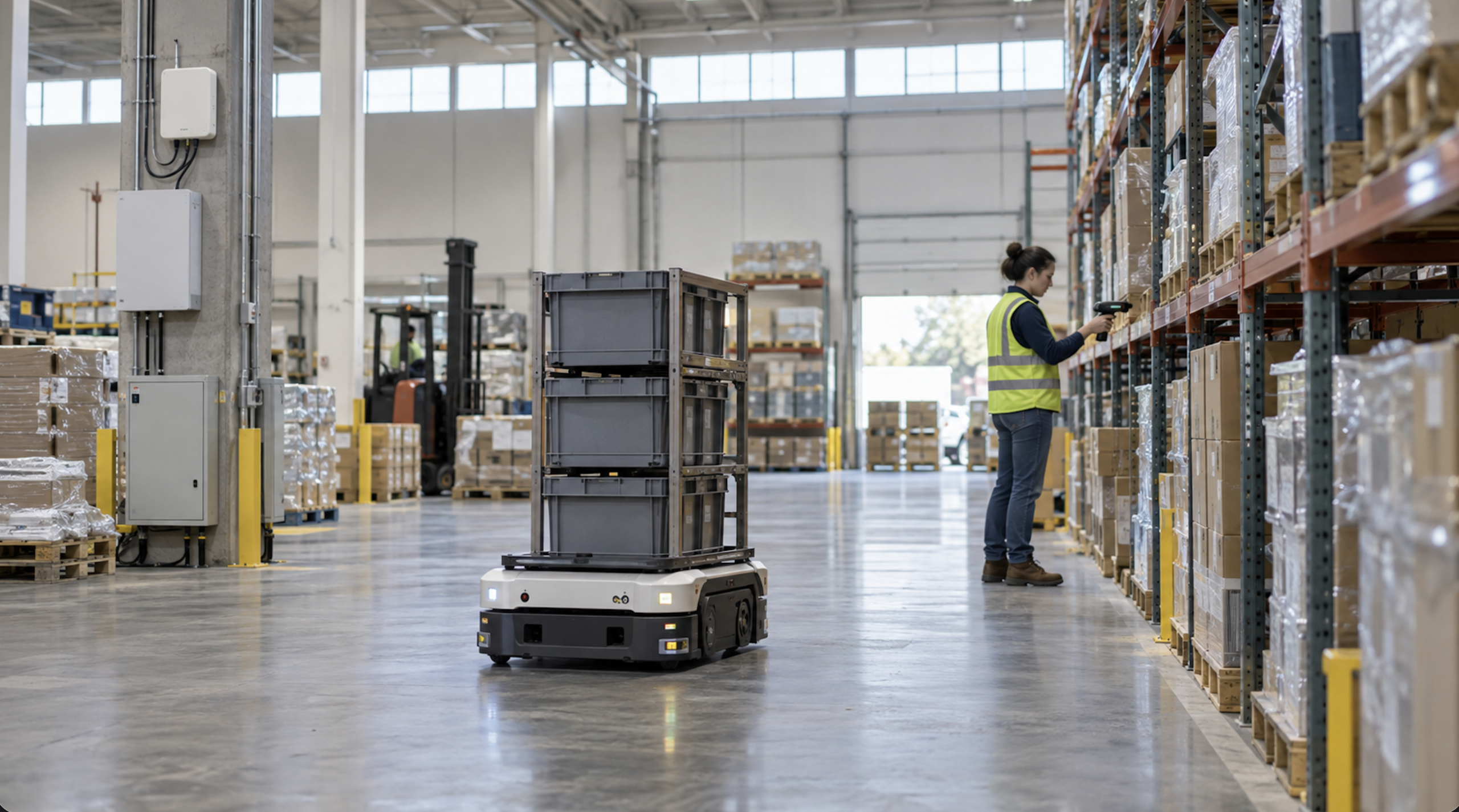
Warehouses bring those considerations together. Zhang describes seeing an 850,000-square-foot facility with more than 200 Wi-Fi access points and a roof roughly 35 feet high. Installing and managing that equipment was complicated. He says adding access points to fix poor connectivity can also create further interference, and argues that private 5G can serve such environments with much fewer access points and lower costs.
Asked about robots and warehouse productivity, he returns to reliability and the need for less day-to-day network management. A cheaper device helps the purchase decision. A network that keeps robots connected and needs less attention changes the cost of running the operation.
From warehouse robots to remote data centers
Late in the conversation, Zhang introduces another application: protecting AI data centers in remote locations where public mobile coverage is unavailable.
He says EdgeNectar has recently signed several contracts to provide video surveillance for such sites, using its integrated CompactOne 5G solution. In this setting, the private network supports the security operation around the data center itself.
Airports are another market where the company has contracts, connecting barcode scanners, payment terminals and cameras. He also identifies mines, oil fields, seaports, university campuses and factories introducing automated guided vehicles as relevant environments of such where EdgeNectar is active today. Looking further ahead, he expects modern office buildings to take an interest in private 5G for security and indoor and outdoor coverage.
The examples are varied, but Zhang offers a practical test for deciding where the technology belongs: is the connectivity mission-critical?
“For moving robots, yes. For outdoor, yes. These are clear mission critical operations”, he says.
He sees growing experimentation with private 5G and expects wider deployment to follow. He also acknowledges the work still required to persuade customers. The technology has a reputation for being expensive and complicated, and a simpler product does not automatically erase that perception.
For Zhang, the goal is an operation in which the customer barely notices the network. Describing companies whose devices keep running, he puts it plainly: “They don’t even know there’s a 5G there. But the device is connected, running all the time.”
Have a question for Ken or the EdgeNectar team? Get in touch — or see our Solutions.