





Ken Zhang is the co-founder and CEO of EdgeNectar. Zhang is a former CTO of Ericsson for Greater China and Northeast Asia, where he contributed to the expansion of the business from a few million dollars to several billion dollars in scale and to the establishment of Ericsson’s largest R&D center outside Sweden. Zhang holds an M.Sc. and Ph.D. from KTH Royal Institute of Technology in Sweden
We sat down with him to talk through what EdgeNectar actually is, the AI technology behind its zero-touch claims, how a private 5G network can be deployed in 10 minutes, and how the company works with partners to scale.
EdgeNectar’s value proposition
Q: How would you explain EdgeNectar’s core value proposition to a non-technical business owner?
“We provide secure, reliable wireless connectivity in places where Wi-Fi fails. Warehouse automation, smart manufacturing, seaports, mining sites, university campuses. These are the demanding environments where a dropped connection stops the whole operation, and that’s exactly where we’re built to work.”
On deployment flexibility
Q: Does every customer get the exact same setup, or does it vary by site?
“We’re fully hardware- and deployment-agnostic. The 5G core can run in the cloud, fully on-premises, or in a hybrid model — a hosted cloud controller paired with an on-prem gateway, which is what most of our customers choose. It runs on standard, off-the-shelf compute, not proprietary hardware, and it supports both regular 3GPP radio and Open RAN. The customer picks the model that fits their data policy and their site. We adapt to them, not the other way around.”
The AI behind “zero-touch”
Q: When you say the system is AI-driven, what does the AI actually do?
“We’re protected by five issued US patents in AI for mobile network operations. That means the system measures latency and performance in real time from every device on the network, and uses that to catch problems before they cause an outage. That’s the difference between a true zero-touch Private 5G network and a network someone still has to babysit.”
On the 10-minute deployment
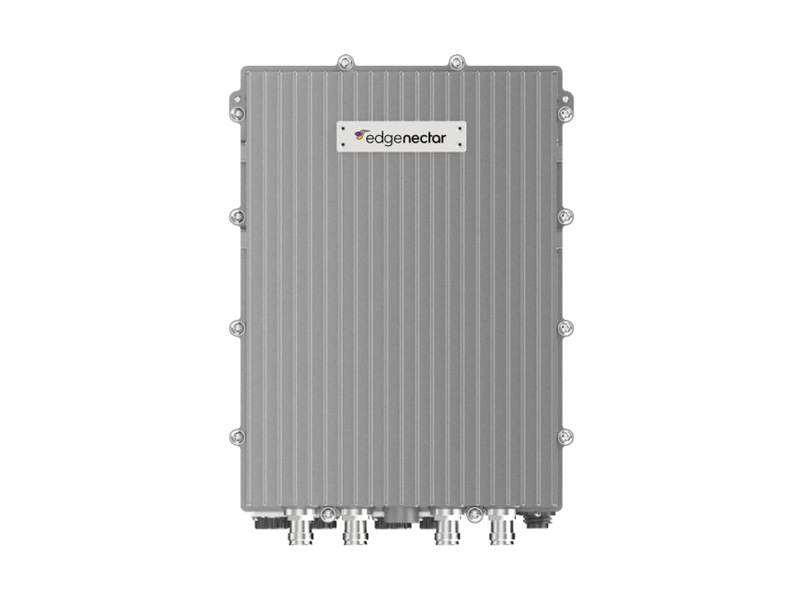
CompactOne 5G — controller and radio in one enclosure.
Q: What differentiates the CompactOne 5G unit from competing hardware?
“CompactOne puts the controller and radio unit in a single enclosure, pre-provisioned and plug-and-play. We’ve deployed a complete network with it in 10 minutes. Competing hardware typically takes months because it needs a specialized integrator on-site to configure it. With CompactOne, you don’t wait on that.”
Q: How is a 10 minute deployment possible?
“Our unique plug-and-play solution is what enables this fast deployment. Everything is pre-provisioned before it ever reaches the site. The controller and radio are already configured as one unit, so there’s no separate box-by-box setup and no waiting on a specialized integrator to arrive and configure the network by hand. Unbox it, connect it, and it’s live.”
Indoor coverage versus Wi-Fi
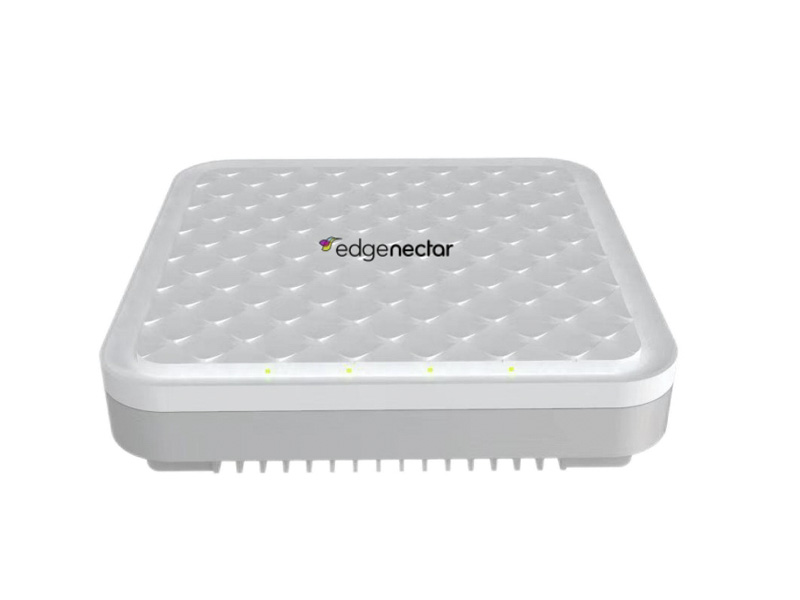
One indoor access point, the same spot you’d put a Wi-Fi AP.
Q: How does the indoor coverage solution compare to a standard Wi-Fi deployment?
“Installation is as simple as a Wi-Fi rollout, but one 5G access point covers 5x the area of a Wi-Fi AP. This means your deployment cost drops by roughly the same factor. Equipment cost is on par with Wi-Fi, and the 5G controller goes in the exact spot you’d otherwise put a Wi-Fi AP. There’s no new site planning required.”
EdgeNectar’s Private 5G competitive moat
Q: What do you see as EdgeNectar’s sustainable competitive advantage over the next 3-5 years?
“Two things, combined. Zero-touch operation powered by our patented AI, and an architecture where the on-prem 5G gateway runs independently while a remote cloud controller handles provisioning on demand. Neither piece alone is unique, it’s the combination of that simplicity with the AI that lets us deploy in 10 minutes instead of weeks.”
On what actually goes wrong in deployments
Q: What are the most common failure scenarios you see in deployments?
“When there’s a conflict, it’s almost always a security concern, not a technical one. We address that by keeping all connectivity and all data inside the enterprise firewall, ensuring that nothing leaves the site. That removes data sovereignty as a blocker before it becomes one.”
Partners, ecosystem, and scale
On scaling the business
Q: EdgeNectar has moved toward channels and distributors. What changed?
“As of mid-2025, our go-to-market shifted to channels and distributors rather than direct sales to individual customers. We’ve streamlined ordering for CompactOne and Edge-20 so partners can set up a trial with almost no friction, because seeing a 10-minute deployment is a far better sales tool than describing one.”
On how partner relationships are structured
Q: What do partners own in this model?
“The partner, channel, or distributor owns the relationship with the end customer — full stop. It’s the model Cisco built its enterprise Wi-Fi business on: we focus on product, our distributors and system integrators face the customer directly.”
The partner, channel, or distributor owns the relationship with the end customer — full stop.
Ken Zhang, Co-founder & CEO, EdgeNectar
The roadmap and the wider ecosystem


Active ecosystem partners: NVIDIA, Arm, and Spectro Cloud.
Q: What’s on the roadmap, and where are the open opportunities for partners?
“We’re an Arm ecosystem partner and a member of NVIDIA’s Inception Program, with active joint projects with Spectro Cloud on virtualization and SynaXG on Open RAN. We’ve also partnered with AT&T ASEoD, using AT&T fiber for backhaul. The direction is the same across all of it: make it faster and simpler to get a private network running, so AI and automation workloads on-site actually have the connectivity they need.”
Have a question for Ken or the EdgeNectar team? Get in touch — or see our Solutions.
Sources
- EdgeNectar private 5G for warehouse automation — case study
- EdgeNectar’s five issued US patents
- EdgeNectar partner and technology ecosystem
Connect with Ken on LinkedIn.