


Private 5G no longer requires a dedicated IT or telecom team when AIDEN closes the operational loop by watching, predicting and correcting network conditions automatically.
Key Findings
- The belief that private 5G requires a specialized IT or telecom team is a holdover from carrier-grade deployment models, not a technical requirement of the technology itself.
- EdgeNectar combines automated provisioning, independent on-premises operation and AIDEN’s continuous self-optimization, shifting routine network operations from the customer to the network itself.
- Organizations without in-house network engineers can deploy and run a private 5G network using existing operations or facilities staff, with no new hires and no specialized certification required.
- The remaining barrier for most enterprises is not technical capability. It is the assumption that private cellular infrastructure demands the same staffing model as a carrier network.
The Assumption Behind the Barrier

AIDEN runs the same closed loop across every site type EdgeNectar serves.
Enterprise buyers evaluating private 5G routinely ask the same question before they ask about coverage, latency, or cost: who is going to run this?
The question is reasonable. Traditional private cellular deployments were built on carrier-grade assumptions: spectrum coordination, radio access network tuning, and a core network that required specialized telecom expertise to configure and maintain. Many private 5G platforms on the market today are still architected around that expectation. Their documentation speaks directly to enterprise IT teams, describing installation, configuration, and ongoing management as tasks those teams are expected to own.
That architecture made sense when private cellular was a telecom project. It stops making sense once private 5G is reframed as network infrastructure that should behave more like Wi-Fi than like a carrier deployment.
What Changes When AIDEN Closes the Loop
A zero-touch private 5G network separates three functions that traditional deployments bundled together:

The on-prem gateway and access point: pre-provisioned, running independently of the cloud.
- Provisioning. A cloud-based controller handles remote provisioning, so there is no manual radio planning or on-site spectrum negotiation before the network can go live.
- Operation. An on-premises gateway runs the network independently of the cloud connection, so day-to-day operation does not depend on a specialist keeping it online.
- Optimization through AIDEN. AIDEN is the autonomous intelligence layer that turns monitoring into action. It continuously evaluates signal quality, latency, jitter, packet loss, throughput and device health against rolling baselines.
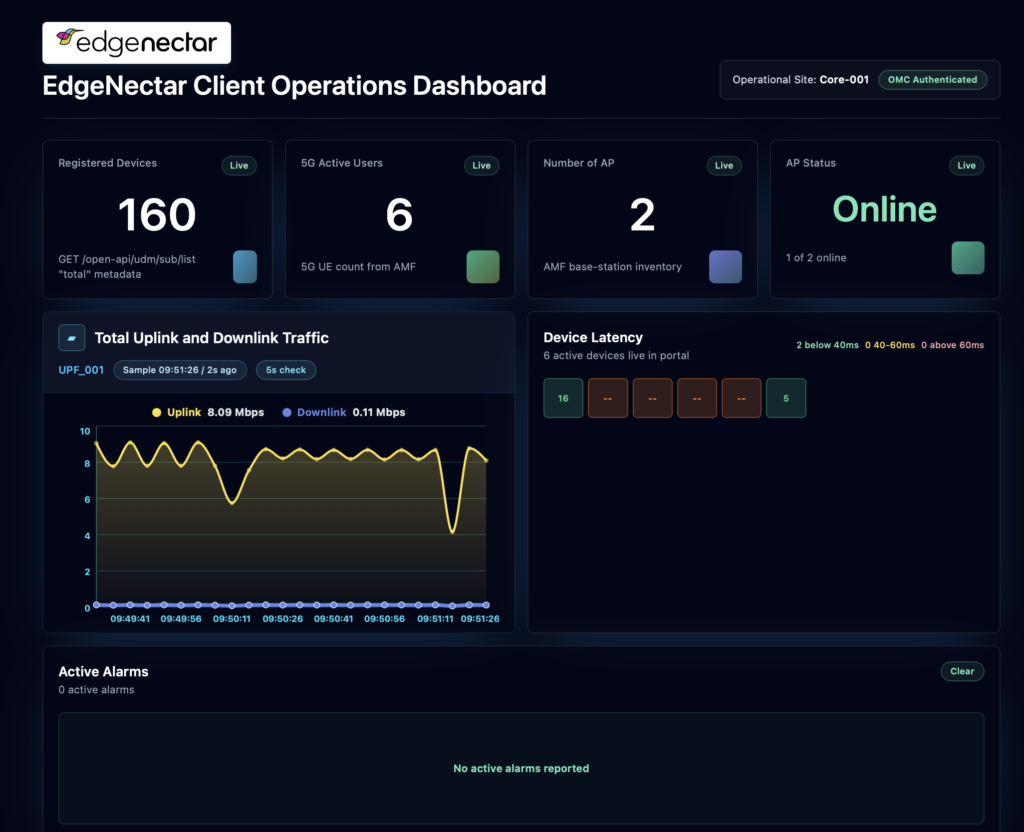
The live conditions AIDEN watches — the same data it uses to predict and correct.
- Watch. AIDEN builds a live picture of conditions across devices and cells.
- Analyze. It identifies meaningful deviations from what is normal for that specific environment, rather than waiting for a static threshold to be crossed.
- Predict. It recognizes developing degradation while it is still a trend, creating an opportunity to act before users experience an outage.
- Heal. AIDEN can reallocate channels or bands, rebalance load or roll back a problematic configuration automatically.
That closed loop is the decisive difference between monitoring and autonomy. Monitoring reports the problem. AIDEN corrects it.
The practical result is a network that installs in minutes rather than months and does not require a standing team to tune it after installation. EdgeNectar’s own deployments illustrate the shift: a fully operational private 5G network, live in 10 minutes, with no specialized integrator on site. Fast deployment removes the initial project burden; AIDEN removes the recurring operational burden. Local operation plus closed-loop correction is what defines autonomous private 5G: the network keeps running and correcting itself on site, without a telecom team behind it.
This Is More Than Just Price Difference
Cost comparisons between private 5G and Wi-Fi have dominated the enterprise conversation for several years, and pricing has largely converged. That makes staffing, not price, the more consequential variable left for buyers to evaluate.
A network that is priced comparably to Wi-Fi but still requires a telecom-trained administrator has not actually solved the adoption problem for a mid-sized manufacturer, a regional hospital system, or a university campus. Those organizations typically do not have a telecom function to assign the work to, and hiring one solely to operate a wireless network rarely clears an internal budget review.
Removing the staffing requirement, rather than just the price premium, is what makes private 5G viable for organizations that were previously priced out by headcount rather than hardware.
Recommendations for Enterprise Buyers
Organizations evaluating private 5G should treat staffing model as a first-order criterion, not an afterthought to be resolved after a vendor is selected.
- Ask what happens after installation, not just during it. A fast install is only useful if ongoing operation is equally low-touch. Ask specifically who performs monitoring, troubleshooting, and optimization once the network is live.
- Confirm whether the network depends on a persistent cloud connection. A network that stops functioning correctly when connectivity to a vendor’s cloud drops introduces a new point of fragility. On-premises components that operate independently reduce that risk.
- Distinguish self-optimization from self-reporting. Some platforms monitor and alert; fewer actually adjust network behavior automatically. Ask for a concrete example of the network correcting a condition without human intervention.
- Map the requirement against your actual org chart. If a proposed deployment assumes a role your organization does not have and does not intend to create, that is a real cost, even if it never appears on the vendor’s invoice.
Conclusion
Private 5G has already solved the coverage and reliability problems that kept it out of reach for many enterprises. The remaining staffing assumption is a carryover from carrier-grade operating models, not a technical necessity. EdgeNectar removes it by combining remote provisioning, independent on-premises operation and AIDEN’s continuous watch, predict and heal loop. Enterprises without a telecom function are not excluded from private 5G. They need a platform designed to fix routine conditions before human attention is required.
Frequently Asked Questions
Do you need an IT department to run a private 5G network?
You need IT, but not a dedicated telecom team. EdgeNectar automates provisioning and on-premises operation, while AIDEN monitors, predicts and corrects routine network conditions.
Existing operations or facilities teams can retain visibility without becoming telecom specialists.
What is zero-touch private 5G?
Genuine zero-touch combines automated provisioning, independent local operation and closed-loop self-optimization.
The test is whether the network can detect and correct a specific condition without waiting for a person to interpret an alert and open a ticket.
How long does it take to deploy a private 5G network?
Deployment time varies by vendor and site complexity.
Zero-touch platforms designed for enterprise use, such as EdgeNectar’s, can be fully operational in 10 minutes, compared with months for traditional carrier-grade deployments.
Is private 5G more expensive than Wi-Fi if you factor in staffing?
When staffing is included in the comparison, a zero-touch private 5G network can be less expensive to operate than Wi-Fi in environments with many access points, since it removes both the per-device management overhead and the need for specialized staff.
EdgeNectar delivers plug-and-play private 5G powered by AIDEN, the autonomous AI network engine that watches, predicts and heals routine network conditions in real time.