


Private 5G for Remote Areas
The University of Nebraska–Lincoln runs an off-grid agricultural research site on a private 5G network from a single solar-powered CompactOne unit, with Starlink backhaul. The network was live in under a day and keeps working when the satellite link drops.
Business impact
The case in brief
- Challenge
- The University of Nebraska–Lincoln (UNL) needed a data network at a remote agricultural research site with no fiber, no grid power and no network specialists on site. Sensors, video surveillance and other research systems had to be connected across the site, and their data collected and processed where it was produced.
- Solution
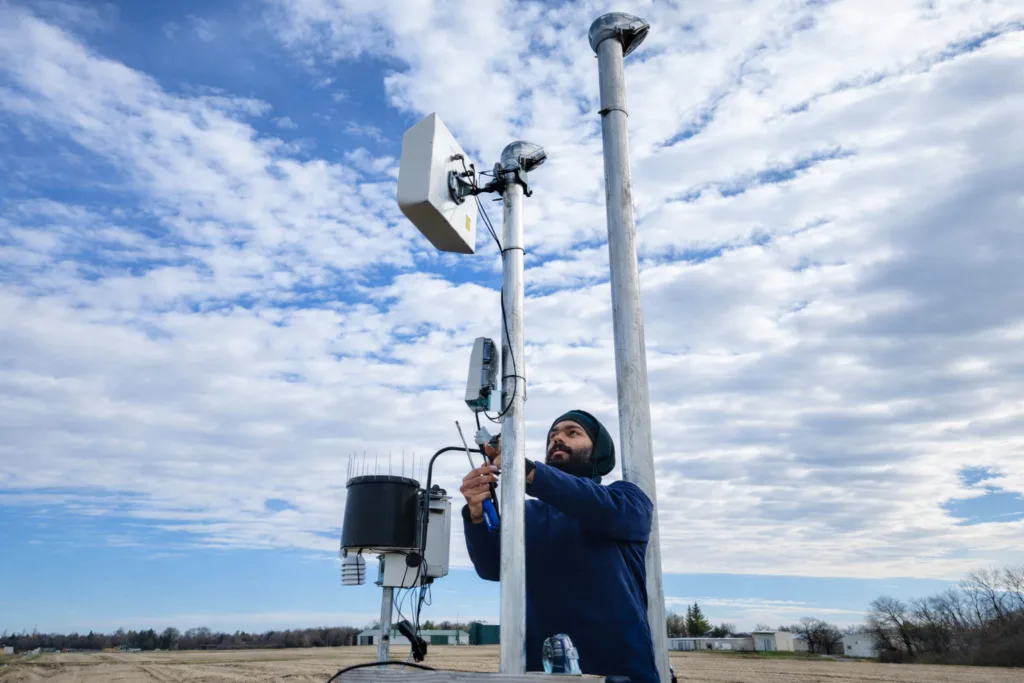
- EdgeNectar delivered a complete private 5G network in a single CompactOne unit, operating in the CBRS band (n48) and powered by solar panels. The 5G core and AIDEN, EdgeNectar’s AI engine for network operations, run inside the unit on site. A Starlink link provides the only external connection.
- Result
- The network was live in under a day, covers the site from one unit and keeps running when the satellite link is down. The site is used on and off for periods of research, and UNL chose the system because it can be set up quickly, without fiber, grid power or telecom expertise.
The site and its requirements
The research site lies in rural Nebraska, outside reliable carrier coverage and far from fiber and the power grid. Bringing fiber out to the site would have meant trenching across open land, and every mast or access point would have needed its own power. UNL’s own systems collect and process the research data, so the network had to carry it locally, not via a cloud service.
The design had four requirements:
Wide-area coverage from minimal infrastructure. Every additional mast needs its own power and mounting.
Low power draw. The full system has to run on solar power.
Local breakout. Device traffic must stay on site and not depend on the satellite link.
Fast set-up and zero-touch operation. The network is set up for research periods, without specialist staff.
Architecture
All network functions run on site. The CompactOne unit integrates the 5G standalone (SA) core, the baseband and the radio, so devices attach, authenticate and exchange traffic locally. Only traffic addressed to external services, and EdgeNectar’s remote management, use the satellite link.
Technical details
CompactOne specifications
Deployment and operation
1Deployment
Live in under a day, from one mounting point.
EdgeNectar ships the system preconfigured: core, radio settings and SIM profiles are prepared before delivery. On site, the unit is mounted and connected to power and backhaul. The network was live in under a day, with no fiber trenching and no grid connection.
Because one unit covers up to a 1-mile radius, the site needed a single mounting point. Additional units can be linked to the first as the site expands, and devices are handed over between cells as they move.
2Operation without the satellite link
Local traffic never depends on the backhaul.
With a cloud-hosted core, every attach, session and packet between two devices on site would cross the satellite link, and the site would stop working whenever the link dropped. Here, the core runs on site. When the Starlink link is down, devices stay attached, local traffic continues, and UNL’s systems keep receiving sensor data and video. Only services that need the internet wait until the link returns. Read why the core’s location decides what happens when the link drops.
3Network operations with AIDEN
No specialists needed on site.
AIDEN polls network KPIs every five seconds, including signal quality, latency, packet loss and throughput, keeps a baseline for each device and cell, and corrects routine deviations automatically through closed-loop actions. It runs on site and does not need the satellite link or a technician, so the network operates itself between research periods as well as during them.
The result is a research site that would otherwise not have been possible, set up quickly and cost-effectively, without trenching fiber or bringing in grid power.
Frequently asked questions
Can private 5G run over satellite backhaul?
Yes. At an off-grid University of Nebraska–Lincoln research site, EdgeNectar’s private 5G network runs over Starlink. Traffic between devices on site is handled locally, and the satellite link is only used to reach the outside world. Because the network does not depend on the link to run, it works with the backhaul the site has, whether that is a low-orbit service such as Starlink, a geostationary satellite, microwave, or fiber when it arrives.
What spectrum does a private 5G network use in the US?
EdgeNectar’s private 5G networks in the US use the CBRS band, n48 (3550–3700 MHz), which enterprises can use without buying a spectrum license. Access is coordinated by a spectrum access system (SAS), and support for it is built into EdgeNectar’s radios.
What happens to a remote private 5G network if the satellite link goes down?
With EdgeNectar, the network keeps working. The 5G core and AIDEN run on site, so devices stay attached, local traffic continues and monitoring goes on. Only services that need the internet wait until the link is restored.
How fast can private 5G be deployed at a remote site?
At the University of Nebraska–Lincoln research site, the network was live in under a day. EdgeNectar delivers the system preconfigured, in one outdoor CompactOne unit with the 5G core built in.
How much power does a remote private 5G system need?
The CompactOne unit draws under 230 W. At the University of Nebraska–Lincoln research site, which has no grid connection, the network runs on solar panels. The unit is rated IP67 and operates from −40 °C to +55 °C.
How does private 5G compare with a satellite terminal or Wi-Fi mesh at a remote site?
A satellite terminal brings internet to one spot, and Wi-Fi or mesh radios need many nodes, each with its own power and mount. One private 5G unit covers up to a 1-mile radius and keeps running if the satellite link drops, because the 5G core is on site.
Can push-to-talk and radio communication run over private 5G?
Yes. Push-to-talk and other radio communication can run within the private network, so crews can reach each other anywhere the network covers. Because the network runs on site, voice keeps working even if the backhaul is down.
How large an area can one outdoor private 5G unit cover?
EdgeNectar’s outdoor unit covers up to a 1-mile (1.6 km) radius in open terrain, depending on terrain, antenna height and frequency band. As the site grows, more units can be linked to the first one, and devices are handed over between them as they move.
Does a remote site need telecom staff to run private 5G?
No. The network operates itself with AIDEN, which monitors it and fixes routine problems on site. EdgeNectar’s remote controller is used only for adding units or SIM cards as the site grows.
Read more
Source: results from an EdgeNectar deployment at a University of Nebraska–Lincoln agricultural research site.
Running a site beyond the reach of fiber?
Describe your site and get an itemized quote by email within minutes, or talk to EdgeNectar about your backhaul and the sensors, cameras, vehicles and people you need to keep connected.